
A single weak password is all that is required to get an entire organization brought down.
Although the majority of individuals visualize hacking as something elaborate and Hollywood-style, in the real world, there are numerous attacks that begin with basic password stealing – and in a few minutes, hackers can locate such passwords.
This is the way they do it, and what is still more important, how you can stop them.
1. The Hunt Begins: Stolen Credentials Everywhere
Hackers do not necessarily hack in the conventional way. They tend to purchase stolen goods.
Whole lists of usernames and passwords are sold at a low price on the dark web – even free of charge.
Since social media logins, corporate emails, and others are previous attacks or infostealer viruses quietly tapped data in infected browsers.
When your workers use the same passwords, your organization might already be compromised and nobody may have hacked it.
2. Credential-Stuffing: Automation at Scale
After gaining credentials, attackers run credential-stuffing bots automated tools that probe leaked usernames-passwords on a variety of platforms.
- A single user can log in to open several services (VPN, email, Slack, cloud dashboards).
- These robots are able to make thousands of logins in a second.
- A majority of the attacks occur during the night when they go undetected until the data has been lost.
Credential-stuffing success rates may be terribly high without multi-factor authentication (MFA) and anomaly detection relating to logins.
3. Password Cracking: Guessing Made Smarter
Hackers are able to guess your credentials when they cannot find them on the Internet, and in this case, they apply more powerful tools, which rely on human patterns.
They rely on:
- Dictionary attacks: Using high probability passwords such as Welcome123 or Spring2025!.
- Brute force: Cycling through millions of combinations.
- Hybrid attacks: Entail using dictionary words alongside numbers or symbols that are foreseeable.
An 8 character password can be broken in less than 10 minutes with modern GPUs.
4. Social Engineering: The Shortcut
In some cases, hackers do not even pass the technical phase.
They attack the staff directly via phishing, counterfeit log-in portals, or impersonation (e.g. a fake email address of some sort, an IT support one).
As soon as the real credentials of an employee are entered, the attackers automatically access them, without malware or brute force.
Be careful about the sender addresses and URLs and you need to enter any password.
5. Shadow IT & Personal Accounts: The Unknown Risk.
Workers tend to use personal equipment or register with unauthorized third-party software with work-related e-mails.
Such websites may not be secure, and once they are compromised, so do your corporate credentials.
According to a survey conducted in 2025, the 62 percent of data leaks involved the reuse of employee accounts on both personal and business systems.
How to Stop the Clock
There is no way to regulate the work of criminals, however, you can ensure that your passwords would never remain their success stories.
- Implement multi-factor authentication (MFA) on a companywide basis.
- Use of very strong and unique passwords per system.
- Install password managers to do away with reuse.
- Train workers on phishing, social engineering.
- On a constant basis, check credentials leakages in the dark web.
The Security of Your Credentials at Vigile
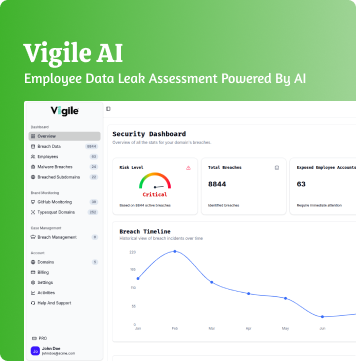
Vigile is a company that specializes in intercepting stolen credentials before they can be used by the attacker. We search the dark-web markets, stealer logs, and in the dark web forums and you are notified when the information about your organization is posted online.
By having Vigile keep an eye on you, you will:
- Find uncovered accounts in real time.
- Eliminate and mitigate high-risk credentials.
- Guard your staff and your business against breaches by credentials.
Vigile turns time into your strongest defense.
Don’t wait for attackers to find you. Visit vigile.ai to see how Vigile helps organizations detect, defend, and stay ahead of password-driven threats.