
The dark web sounds like a movie story or hackers playground and this is the very reason why this is not taken seriously by many business leaders.
As a matter of fact, the dark web is an underground international marketplace, in which cybercriminals sell and purchase all types of stolen credentials and internal files, ransomware packages and access points to corporate networks.
And here is the issue: when you fail to understand it, your business is at risk.
We should deflate the darkest myths of the dark-web to enable you to protect your organization in a clear and quick manner.
Myth 1: The Dark Web does not Impact my Company.
This is among one of the most dangerous cybersecurity assumptions.
It can still find its way there even with an insignificant or middle-size company of yours whose information, or credentials of your personnel, can still leak into it. Big brands are not the only targets of attackers. They raid any target that has value and insecure defense.
In case your log ins, company files, or client files are leaked, hackers will use them to:
- Credential-stuffing attacks
- Business email compromise
- Ransomware campaigns
- Corporate espionage
Reality:
Any company, large or small, is a kind of a commodity in the dark web.
Myth 2: We would have heard about our Credentials being leaked.
Many leaks happen silently. The staff is hardly aware of whether their browser-stored passwords or session tokens have been stolen by malware.
Hackers usually publish compromised credentials in:
- Private Telegram groups
- Closed cybercrime forums
- Infostealer stock markets.
- Auction-only leak boards
When a leakage is released, intruders might already attempt to utilize your access.
Reality:
Credential leaks do not often declare themselves, detection tools have to.
Myth Number 3: Dark Web Surveillance Only Banks and Big Tech.
There is no discrimination when it comes to attackers, they automate.
Retail, SaaS, healthcare, fintech, logistics, education – there is no industry that will escape.
Actually, SMEs tend to be more vulnerable since they are not well monitored and are under the assumption of being safe.
When the credentials of your CEO, finance officer or engineer are leaked, you are putting your whole business ecosystem at risk.
Reality:
All the industries that have business email and cloud logins are vulnerable.
Myth #4: We Have Antivirus and MFA We are safe.
These are the tools that are needed – not only enough.
Why?
Infostealer malware evades antiviruses since it conceals itself within legitimate processes.
With session tokens, attackers do not have to go through MFA at all.
It is an indication that stolen browser cookies or Slack can allow hackers to log in without any idea of a password.
Reality:
There are no attacks on devices alone, but identity in modern attacks, and sale of that identity in the dark web encourages breaches.
Myth 5: When It Happens, We Can Respond.
The old type of security is reaction-only, which is costly.
Attackers can have:
- Logged into your cloud apps
- Planted persistence backdoors.
- Added new hidden users
- Outflowing classified documents.
The actual price is not the breach it is the lag to detect.
Reality:
Exposure in dark-web has to be preempted before exploitation occurs.
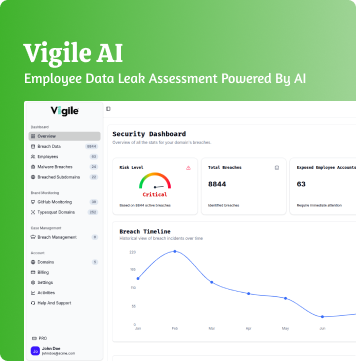
Develop Dark-Web Insight into Security Strength using Vigile.
Vigile provides organizations with the visibility it requires in order to be on top.
Our platform tracks:
- Dark-web leak forums
- Credential dumps of infostealers.
- Access-broker marketplaces
- Weakened employee accounts.
- Corporate domain exposures
You receive real-time notification of threats and action to mitigate them when they occur – quickly.
Rather than praying your company does not feature in dark-web discussions…
Vigile assures you, know you will- be-known.
Be ahead of cybercriminals. Get in-the-field learning on dark-web intelligence in real-time at vigile.ai and safeguard your own business against unknown threats.