
Introduction
Credential security is no longer a nice to have. In 2026, it is a baseline requirement for any organization that takes its digital safety seriously. Yet despite the growing threat landscape, many companies are still operating with outdated practices, incomplete coverage, and dangerous blind spots.
This checklist is designed to give security teams and business leaders a clear, actionable framework for where they stand and what they still need to address.
1. Audit All Employee Credentials Across Every System
Start with the basics. Do you know every system, tool, and platform your employees have access to? Many organizations are surprised to discover the sheer number of accounts that exist across their workforce, including forgotten tools, legacy systems, and shadow IT applications.
Conduct a full credential audit across your organization. Map every account to every employee. Identify orphaned accounts from former staff. Build a complete picture of your credential landscape before you can protect it.
2. Enforce Multi-Factor Authentication Everywhere
Multi-factor authentication is one of the single most effective defenses against credential-based attacks. Yet many organizations still have gaps, applying it to primary systems but leaving secondary tools, admin panels, and third-party integrations unprotected.
In 2026 there is no acceptable reason for any corporate system to be accessible with a password alone. MFA should be non-negotiable and enforced across every single access point without exception.
3. Implement a Strong Password Policy and Actually Enforce It
Password policies exist in most organizations. Enforced password policies are far rarer. Employees find workarounds, reuse old passwords with minor variations, and choose convenience over security every single time they are given the option.
A strong password policy in 2026 means minimum length requirements, mandatory complexity, regular rotation for high-privilege accounts, and technical enforcement rather than just written guidelines. If your policy relies on employee discipline alone, it is not a policy. It is a suggestion.
4. Monitor for Credential Reuse Across Personal and Corporate Accounts
One of the most persistent and dangerous credential habits is reuse. Employees who use the same password for their corporate email and their personal streaming accounts create a direct bridge between consumer data breaches and corporate security incidents.
Organizations cannot control what employees do with their personal accounts but they can monitor for the consequences. Dark web monitoring tools can identify when corporate email addresses appear in consumer breach data, flagging potential reuse risks before they become corporate incidents.
5. Set Up Real-Time Dark Web Monitoring
This is no longer optional. Credentials appear on the dark web within hours of a breach and attackers move fast. Waiting for a periodic report or a manual scan means you are always operating with outdated information.
Real-time dark web monitoring gives your security team immediate visibility the moment any employee credential surfaces in a dump, forum post, or marketplace listing. That early warning is the difference between containing an incident and managing a crisis.
6. Train Employees on Phishing and Credential Theft Regularly
Technology alone cannot solve the credential security problem. Human behavior remains one of the most exploited attack vectors. Phishing emails, fake login pages, and social engineering attacks are responsible for a significant proportion of credential theft globally.
Regular training keeps employees alert to current tactics. But training in 2026 needs to go beyond annual slideshows. It needs to be frequent, realistic, and include simulated phishing exercises that test actual behavior rather than just knowledge.
7. Monitor and Control Third Party App Access
Every third-party application your employees connect to your corporate systems is a potential entry point for attackers. OAuth connections, API integrations, and browser extensions all carry risk that many organizations significantly underestimate.
Conduct a full audit of third-party app connections across your organization. Revoke access for tools that are no longer actively used. Establish an approval process for new integrations. And monitor third-party services for breach news so you can act immediately when a connected service is compromised.
8. Create an Incident Response Plan Specifically for Credential Breaches
Most organizations have a general incident response plan. Far fewer have one specifically designed for credential breach scenarios. These situations move fast and require a very specific set of actions including immediate password resets, session token invalidation, affected system isolation, and user communication.
Having a pre-built playbook for credential breach response means your team is executing a rehearsed plan under pressure rather than improvising. Every minute saved in the early stages of a credential incident directly reduces the final damage.
9. Review and Reduce Privileged Access Regularly
Privileged accounts, those with administrative or elevated access, are the most valuable targets for attackers. They are also among the most poorly managed in most organizations. Employees accumulate privileges over time that they no longer need. Former staff sometimes retain access longer than they should. Service accounts sit dormant with powerful permissions and no active monitoring.
Conduct quarterly reviews of all privileged access. Apply the principle of least privilege rigorously. Remove access that is not actively required. The smaller your privileged attack surface, the less damage a compromised credential can do.
10. Measure Your Credential Exposure Right Now
Everything on this checklist assumes you know where you stand. But many organizations have no idea how much of their credential data is already out there, sitting in breach databases, credential dumps, and dark web marketplaces waiting to be used.
Before you can improve your credential security posture, you need a baseline. Check how many of your employees’ credentials are already exposed. Understand which systems are most at risk. Identify the gaps in your current coverage.
That baseline is the foundation everything else gets built on.
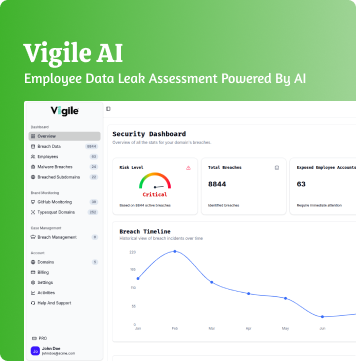
Vigile.AI gives you that baseline instantly. Check your company’s full credential exposure for free at vigile.ai
Conclusion
Credential security in 2026 is not a single tool or a single policy. It is a layered, continuous practice that touches technology, people, and processes across your entire organization.
This checklist is not meant to overwhelm. It is meant to give you a clear starting point. Pick the items where your organization has the most gaps and start there. Because in credential security, progress matters more than perfection, and any improvement you make today reduces your risk tomorrow.
The question is not whether your organization needs better credential security. It is how much longer you can afford to wait.