
Introduction
Remote work transformed the way organizations operate. It opened up global talent pools, reduced overhead, and gave employees the flexibility they had long been asking for. But it also quietly created one of the most significant credential security challenges that organizations have ever faced.
The office perimeter is gone. And with it, much of the security infrastructure that organizations spent decades building and trusting.
The Security Perimeter That No Longer Exists
In a traditional office environment, security teams had a defined boundary to protect. Corporate devices on a corporate network behind a corporate firewall. Monitoring was centralized. Anomalies were easier to spot. Access was controlled.
Remote work shattered that model entirely. Employees now connect from home networks, coffee shops, co-working spaces, and airport lounges. They use personal devices alongside corporate ones. They access company systems through a patchwork of VPNs, cloud tools, and browser-based applications.
Every one of those connection points is a potential vulnerability. And credentials sit at the center of all of them.
Personal Devices Are a Security Blind Spot
One of the most underestimated risks in a distributed workforce is the personal device problem. Employees who work remotely often blur the line between personal and professional use. The same laptop used for corporate email gets used for personal shopping, gaming, and social media. The same browser that accesses company systems stores personal passwords in an unencrypted local vault.
When that personal device gets infected with malware, everything on it becomes compromised. Corporate credentials, session tokens, saved passwords, and authentication cookies can all be harvested silently without the employee ever noticing.
IT teams have limited visibility into personal devices and even less control over how they are used. This creates a blind spot that attackers know how to exploit.
Home Networks Are Not Corporate Networks
A corporate office network is monitored, segmented, and regularly audited. A home network is none of those things. Default router passwords, outdated firmware, shared connections with family members, and zero network monitoring make home networks significantly easier to compromise.
An attacker who gains access to a home network can intercept traffic, perform man-in-the-middle attacks, and harvest credentials as they travel between a device and a corporate system. Most employees have no idea this is even possible, let alone actively happening.
Shadow IT Explodes in Remote Environments
When employees work remotely, they tend to solve problems independently. Need a quick file sharing solution? They find one. Need a communication tool their team does not officially use? They sign up. Need to access a resource blocked by the VPN? They find a workaround.
This is called shadow IT, and it explodes in remote work environments. Employees sign up for dozens of third-party tools using their corporate email addresses and often reuse company passwords out of convenience.
When any one of those third-party services gets breached, corporate credentials are suddenly in the wild. And because IT never knew about those tools in the first place, they have no way of knowing the exposure has happened.
Password Reuse Remains the Achilles Heel
Despite years of security awareness training, password reuse remains one of the most persistent problems in credential security. Employees use the same password across multiple services because it is convenient and because they genuinely believe the risk is low.
In a remote work environment, this habit is even more dangerous. Credentials flow across more platforms, more devices, and more networks than ever before. A single reused password exposed through a personal account breach can cascade into full corporate access for an attacker.
The Visibility Gap Remote Work Creates
Perhaps the most dangerous aspect of remote work from a security standpoint is the visibility gap it creates. Security teams cannot see what they cannot monitor. When employees work across personal devices, home networks, and unsanctioned tools, significant portions of credential activity happen completely outside the organization’s view.
Threats that would have triggered alerts in a traditional office environment go completely undetected in a distributed one. By the time something surfaces, the damage is already done.
What Organizations Need to Do Differently
Addressing credential security in a remote work environment requires a fundamentally different approach. Security awareness training helps but is not enough on its own. VPNs and multi-factor authentication add important layers but do not solve the full problem.
What remote-first organizations need is continuous external visibility. Monitoring that operates outside the corporate perimeter, watching for employee credentials wherever they might appear. On dark web forums, in credential dumps, in malware logs harvested from compromised personal devices.
Because if an employee’s credentials are out there, the only question that matters is whether your security team finds out before an attacker does.
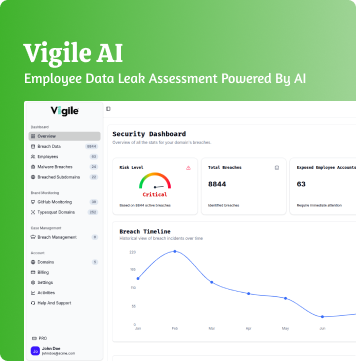
Vigile.AI provides exactly that visibility. By continuously monitoring 300B+ leaked records across the dark web, paste sites, and malware logs, Vigile alerts your team the moment any employee credential surfaces, regardless of which device or network it came from.
Check your company’s exposure for free at vigile.ai
Conclusion
Remote work is not going away. The flexibility and productivity benefits are too significant for most organizations to reverse. But the credential security risks it introduces are real, growing, and dangerously underestimated.
The perimeter is gone. The blind spots are everywhere. And the only way to stay ahead is to extend your visibility beyond the boundaries of what you can directly control.
Because in a distributed workforce, your biggest security risk is not a sophisticated attacker. It is the employee on a home network, on a personal device, using the same password they use for everything else.